We're going back to the Moon! Okay, it's with a robot right now, but hey, let's take what we can get! LADEE, or the Lunar Atmosphere and Dust Environment Explorer, will launch from the Wallops Island Flight Facility here in Virginia on September 6th. That means we should have a great view of the launch...as will much of the east coast of the United States, in fact.
 |
| The LADEE Spacecraft. Courtesy Wikipedia. |
Wait a minute...Lunar Atmosphere? Yes, lunar atmosphere. Most of the time, when we talk about the Moon, we say it has no atmosphere. That's because for all practical purposes, it doesn't. There's certainly nothing like air that we could breathe. And yet, there are some tenuous gases around the Moon...and I do mean tenuous. The pressure of the "lunar atmosphere" is less than one hundred trillionth of Earth's atmospheric pressure at sea level. You don't get more tenuous than that! It seems to mostly be comprised of argon, helium, sodium, potassium and hydrogen, most of which probably comes from outgassing from the Moon itself. But we'd like to know more about this "atmosphere," where it comes from, and what effect it may have on any future (and perhaps permanent) missions to the Moon.
And then there's dust. Dust is tricky stuff in space. It can make for some real problems. The Moon's surface is covered in dust - lunar regolith is essentially dust-sized particulates and they can get everywhere. A major challenge for any equipment working in the lunar environment is how to deal with the lunar dust. The more we know about it, the better we can plan to handle the dust as we eventually head back to the Moon, hopefully, to stay.
Dust may also be the answer to an enduring mystery that came out of the Apollo missions. Apollo astronauts reported seeing mysterious glows and rays above the lunar surface. These could have been caused by sodium ions...or they could have been caused by sunlight shining on dust in the lunar atmosphere. LADEE will be seeking the answer to this enduring mystery.
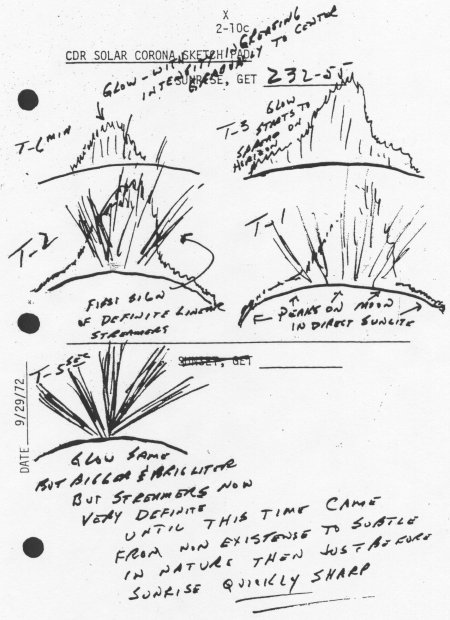 |
| A sketch made by Apollo astronauts showing the glows and rays observed above the Moon. Courtesy Wikipedia. |
Watch my blog for more information on when and where to look for LADEE's launch as we get closer to T minus zero. If all goes well, on September 6, Virginia will be host to an amazing sight - and the start of a 3 to 9 month exploration of more mysteries of the Moon.
Until then,
Carpe noctem!
Kelly


