Subtitle

Written by Kelly Herbst, Astronomy Curator for the Virginia Living Museum. Updated every two weeks, more or less.
Showing posts with label binoculars. Show all posts

Wednesday, April 10, 2013

UFOs and All That

Greetings, fellow Earthlings!

So, have you been watching television lately?  There seems to be a new fascination with UFO hunting and finding and proving and conspiracy theorizing out there of late.  So I thought I'd write a little about UFOs and what they do...and don't...mean.

When most of us hear the term "UFO" we think aliens!  Spaceships!  Take me to your leader!  Beam me up, Scotty, there's no intelligent life down here!  But actually, UFO stands for something specific: Unidentified Flying Object.  A UFO is nothing more than something flying in the sky that has not yet been positively identified.  It does not mean the purple pod people have come to eat our brains.  Most of what these shows tout as "aliens" are MFOs - Misidentified Flying Objects (thanks, Phil Plait!).  Someone sees something in the sky and misinterprets it as an alien spacecraft.

So what are the most common MFOs?  Here are the top three:

Believe it or not, I get those phone calls here.  Very nice, normal, not crazy people who call me up and explain they saw something very bright, low to the horizon, which appeared to shift and wiggle around, and change color every so often.  Don't panic, I tell them, you've just seen the most common MFO in the world: the planet Venus.  Venus is the brightest object in the sky after the Sun and Moon - it's quite impressive, even in a sky that is not yet dark.  Since Venus orbits the Sun closer in than we do, the planet can never been seen in the skies of Earth more than 45 degrees away from the Sun.  So Venus is frequently seen low to the horizon.  When you look at an object low on the horizon, the light coming from that object has to pass through a lot more air to reach your eyes than a similar object directly overhead.  Well, the moving air of Earth is what causes twinkling - the phenomenon of stars (or planets!) seeming to flash, move, and change color.  So all in all, Venus makes a perfect faux alien spacecraft.

Surely that bright light is an approaching spacecraft!  See the reflection of it in the water!  It can't be a planet!  But it is. It's Venus, seen here in the pre-dawn skies of Earth.  And yes, Venus is so bright, it often shows reflections and casts shadows.  Image courtesy Wikimedia Commons.

It's not just Venus either.  The second brightest planet in the sky, Jupiter, can also fool people into thinking they've seen aliens.  Since Jupiter is an outer planet, it is more likely to be seen high in the sky, mostly eliminating the twinkling effect.  So why do people think it's a spacecraft?  Well, imagine seeing a bright light in the sky.  You don't know what it is, so you grab a pair of binoculars to get a better look.  Suddenly, that single light becomes 5 lights - one big one in the center surrounded by 4 small ones...and it seems to be moving!  Yep, this happens a lot.  Jupiter is surrounded by moons - and the four largest are easily visible in a pair of binoculars...or with modern high-powered TV cameras.  The motion effect is caused by difficulties in holding the binocs or camera steady while viewing.  Sure enough, TV crews sent to check out reports of a UFO have often "confirmed" it with their cameras...only to be told later by local astronomers they were viewing Jupiter.  Oops.

Surely this one is aliens!  Look at the symmetry!  They must be lights on a spacecraft!  Nope, the center bright light is Jupiter and the 4 smaller lights are the giant planet's largest moons, seen here through a powerful camera.  Image courtesy Satellite Imagination.

Last, but certainly not least, is one that most people can't believe could be true.  One of the more common MFOs is...birds.  Really!  Birds!  Especially when seen close to sunset or sunrise flying in formation.  Lighting can really do funny things to your perception of objects in the sky...and a flock of birds flying in formation eerily lit by the Sun and artificial lights can rapidly convince you you're watching the aliens come in for a landing.  Trust me...I've seen the effect.  I was almost convinced...until my "spacecraft" started honking...they were geese.

Okay, this one HAS to be a spacecraft!  Just look at it!  Or...
...is it a bird?  Yeah, it's a blurry bird picture.  Images by Rob S.

So the next time you see something in the sky you can't identify, don't call the guys from the History Channel show - call me.  Or post a comment here on my blog.  I'm only too glad to help turn UFOs into IFOs (Identified Flying Objects).  And if ever we do make contact, it will almost certainly be by radio.  Any alien civilization capable of talking to us must located very far away - too far for a spacecraft to be of any help - or we'd have met them by now.

But we can still hope, right?
Until next time,
Carpe noctem!
Kelly

Wednesday, March 13, 2013

It's a bird...it's a plane...it's a COMET!

Greetings astronomy fans!

Well, it's here!  The first of the two comets touted to put on great shows in our skies this year.  Comet PanSTARRS has arrived!

Yep.  It's here

Okay, sorry if I sound a little bummed.  But I'd give my right arm to be in the southern hemisphere.  They've had extraordinary views of Comet PanSTARRS for quite some while now...and Comet Lemmon too!  And Comet McNaught last year!  It's been a veritable comet bonanza for our friends down under...and dang it, I am jealous!

But all is not lost here in the great white North.  I tried to see Comet PanSTARRS last night, but lingering clouds and light pollution made it impossible (I did see a fantastically young crescent Moon, however - youngest I've ever seen!).  But it should get easier tonight, as the comet is inching itself away from the Sun day after day.  That's going to both help (further from the Sun means it will be in a darker sky and easier to see) and hurt (further from the Sun means the comet itself will be a dimmer object) - but over the next couple of days we'll have our best chance to see this little interloper.  So how do we do that?  Here are some tips!

  • Find a location with as little light pollution as possible.  Get away from as many city lights as you can.
  • This same location also needs to have as flat a western horizon as possible.  The more sky you can see to the west, the better.
  • Start looking to the west just after sunset.  Focus your attention to the left of the brightest sunset glow.
  • Look for a very slender crescent Moon.  It will be up and to the left of the sunset.
  • Once you see the Moon, look between the Moon and the sunset glow for the comet!
A finder chart for Comet PanSTARRS.  Courtesy space.com.

Trust me, it will not be easy to see.  Binoculars may come in handy, but use them carefully and ONLY after the Sun has completely dipped below the horizon.  Seeing a comet is not worth losing an eye for.

A camera will help a lot, if you are confident enough to try it and have one of those "old-fashioned" cameras you can force to leave the shutter open for more than a tenth of a second.  Witness the power of the two-second exposure:

Comet PanSTARRS from Louisiana on March 12.  Image by Mike B. Courtesy Cloudy Skies Telescope Reviews.

So, sadly, Comet PanSTARRS is fainter than we hoped it would be by now.  Comets are tricky beasts - chunks of ice and rock left over from the early days of the solar system's formation.  When they dive close to the Sun like this one has, the ices warm and turn directly to gas, creating an often intricate and beautiful tail of materials stretching for millions of miles.  But the brightness of a comet is determined by the amount of ice as compared to rock (ice is shiny and bright and rock is dull and dim), so there's never really a good way to know if a comet is going to be bright or not...until it arrives.  Also, this appears to be Comet PanSTARRS first (and possibly only) trip close to the Sun, so the intense heating may have driven all the ices off, leaving not much left for us to see now that the comet has rounded the Sun.

I wish you all the best of luck in your efforts to see Comet PanSTARRS...and never fear, there's still Comet ISON to come later this year.  It's being touted as the "Comet of the Century" - but of course, we'll just have to wait and see.

Until next time,
Carpe noctem!
Kelly

Wednesday, February 27, 2013

What's Up?

Well, hello.

It's been an eventful time in the astronomy business, thanks to a chunk of rock that decided to scare the living daylights out of a whole lot of people living in Siberia.  Amazingly, they seem to like air-bursting asteroids...once again, just like in 1908, a chunk of space rock exploded rather than impacting.  Since this one did so over a city, many people were injured when they rushed to look out their windows to see what the bright flash of light was.  Once the shock wave hit, the windows shattered, glass went flying, and many people were hurt.  But fortunately, I do not believe there were any deaths associated with the event.  But my goodness, it must have been quite scary to experience that first hand.  We talked about the 1908 event in our previous chat...when I wrote that I had no idea it would be happening again so soon!

The fireball over Siberia on February 15, 2013.


Anyway, let's turn ourselves to a calmer exploration of the sky.  It's been a while since I wrote a nice, simple post about things appearing in the skies above, so I think it's time to do that again.

The early evening skies are currently dominated by the largest planet in the solar system - Jupiter.  Shining brighter than all the visible stars, Jupiter is easily seen high in the southwest after sunset.  It's currently located in the constellation Taurus the Bull, right behind the bull's V-shaped face.  Taurus, of course, is facing off with Orion the Hunter, brightest constellation of our sky and easily visible high in the south.  So just by looking southward after sunset you should be able to quickly find the seven bright stars of Orion.  Use the belt of Orion (three stars in an almost perfect straight line) to find Taurus by following the line it makes away from Orion towards the right.  The belt will point you to the brightest star of Taurus, reddish Aldebaran.  This is the upper left point of the V of Taurus' face.  Right next to the V will be Jupiter, almost shocking in its brightness.

Following Orion's Belt to Aldebaran, the red right eye of Taurus the Bull.  In February of 2013, Jupiter is located between the V of Taurus' face and the Pleiades.

Jupiter is an incredible world.  Ten times bigger than our own planet Earth, Jupiter is a gas giant and the largest of the solar system's planets.  Even so, it is still much too small to be a star...Jupiter would have to be 10 times again as big as it is to become a star like the Sun.  The gravity of mighty Jupiter holds over 60 moons in orbit around the massive world, and even supports a tiny, thin ring system, completely invisible from Earth.  Only visiting spacecraft have the opportunity to see the rings of Jupiter, and they have fortunately sent lovely pictures back to us here on Earth.  Known from ancient times, Jupiter has long fascinated us, and it has been the target of numerous missions including the Voyager space probes and the Galileo spacecraft.  Another mission, Juno, is on its way, with a planned arrival in July of 2016.

The giant planet Jupiter.

The only other planet currently visible to us is Saturn, which graces the early morning sky before the dawn.  You'll see Saturn as a golden-yellow star-like object shining in the south before the Sun rises.  A pair of binoculars is all that is needed to reveal the lovely Saturnian rings, but you will need to hold them very steady.  A tripod will serve you well.  And be prepared to get up quite early - 5AM is the best time to see Saturn these days.  If you'd rather see it at a more convenient time...wait a few months.  Later in the year, Saturn will become an early evening object rather than an early morning one.

Saturn and its amazing ring system.

So everyone take a deep breath, relax, and enjoy the sky.  I promise, despite the events of recent days, the world is not coming to an end.  Hopefully the sky will give us a few days to catch our breath before the next potential big event - Comet PANSTARRS.  If the comet becomes something worth venturing outside to see, I'll put out a Cosmic Strings Alert to let you know.

Barring that, I'll see you in two weeks!
Carpe noctem!
Kelly

Wednesday, November 21, 2012

Pass the Astronomy, Please

Happy Day Before Thanksgiving!

I'm in a food mood, folks.  I'm looking forward to Thanksgiving this year.  Maybe because I don't have to do all the cooking myself this time!  Or maybe because the Mythbusters took on some classic food myths - including that turkey tale of tryptophan.  But whatever it is...let's take a moment to explore some ways to bring a little astronomical fun to the holiday.

Of course, the first thing that comes to mind is just get outside!  After the massive meal and the inevitable 4 hours on the couch to recover, get up and head outdoors.  It will be dark by then, and maybe you'll be treated to some lovely sights!  As early as 6pm, the Moon will be climbing high towards the south, being just a bit past first quarter at that point.  This will be a great time to get out the binoculars or a telescope and sweep along the terminator - the line of shadow that separates day and night on the Moon (or any other celestial body) - and explore the wonders of the lunar surface.  The deep shadows to be found at the terminator make for an excellent view of mountains, craters, and other magnificent features.

The Moon's terminator.  Note the strong detail visible thanks to the deep shadows.  Courtesy stargazing.net


By 9:30pm, Jupiter will be a blazing beacon of white light in the eastern sky.  It will be tantalizingly close to the red right eye of Taurus the Bull, Aldebaran.  The color contrast should be quite lovely.  And here again, a telescope or binoculars will provide some extra excitement, showing you several Jovian moons and maybe a couple of cloud bands on the massive planet.

Jupiter and its 4 largest moons as seen through a small telescope.  Courtesy Universe Today.


But perhaps you're just not going to be able to get up off that couch.  Maybe we'd better add some astronomical fun to the meal itself, or there's no chance you'll get anything spacey in at all.

One easy way to stellar up any meal is with a little starfruit!  When you slice this unique little fruit correctly, the pieces come out star-shaped.  Scatter them around as garnish on almost any dish - they have a mild, white-grape like flavor which is very pleasant and goes with almost anything.

Star fruit, shown whole and sliced.  Image courtesy www.yummy-ness.tumblr.com

For those who really want to do up the astronomical flair - may I suggest a little pizazz during the pie course?  Big round things always put me in mind of the planets.  Perhaps an apple pie might be topped with a red-food-coloring tinted top crust and become the surface of Mars!  Or the whipped cream on top of the pumpkin or coconut cream pie might be striped to look suspiciously like the clouds of Venus or Saturn.

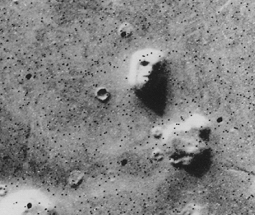
Gracious, I've just given a whole new meaning to "The Face on Mars," haven't I?


However you celebrate, be it astronomically or not, have a wonderful and peaceful Thanksgiving.
Carpe noctem!
Kelly

Wednesday, December 7, 2011

'Tis the Season

Hey folks!

We started talking holidays two weeks ago, so I thought I'd keep it up, as we get a lot of calls around this time of year about good astronomy Christmas gifts.

My Dad loved Christmas.  He loved shopping...especially if he could get a bargain!  And then to have the joy of giving that bargain to someone and watching their face light up...to him, that was the best thing ever.  But as every good bargain hunter knows...my Dad included...sometimes, a bargain turns out to be a raw deal.  To help you avoid the pitfalls as you shop for your favorite astronomy buff this season, here are my Do's and Don't's of astronomy holiday shopping.

DO find out what your astronomy-lover is looking for.
Anyone into astronomy as a hobby almost always has a list of things they've been just dying to get!  And it doesn't necessarily have to be an expensive list either.  Honestly, this is true for any gift...you're more likely to get the right thing if you ask what the right thing is.

DON'T "name" or "buy" a star for your astronomer.
It's a holiday bummer I deal with every year...a well-meaning shopper buys or names a star for their favorite astronomy-lover through one of a dozen companies offering the service.  Some are even geared towards kids, selling a stuffed animal to go with the gift.  Before you drop the $50 - $150 these things often cost, be aware of several things.  No one can buy or sell a star or the right to name a star.  It is against international law to do so.  These companies charge a lot of money for you to send your name in and they print it in a book that gets locked in a vault.  The names are NOT official, nor will any astronomer ever see them or use them.  These companies use extremely dim stars, well below the limits of human vision, and in some cases below the ability of most amateur-grade telescopes!  You will likely never be able to see the star you've "purchased."  In some tragic cases, I've discovered that these companies have made up stars - adding dots to star charts with a marker where no star actually is located.  At best, these items are a novelty gift...at worst, they are out-and-out fraud.  Save your money for a more practical gift, rather than blowing it on a pretty certificate and a poorly-made star map.

Sirius, the brightest star in the nighttime sky.  Try as you might, you won't be able to rename it for your mom.
Courtesy NASA.


DO purchase a gift membership to your local planetarium for your astro-pal!
A one-year membership to your local planetarium/museum is a gift that keeps on giving all year...and in many cases you can share it with your buddy!  If you're trying to keep costs down, check to see if your museum of choice offers an individual membership - that can be a a great cost-saver!  If you live in the southeastern Virginia area, check out gift memberships to the Virginia Living Museum and give them the gift of the Abbitt Planetarium and Observatory for a year!

DON'T buy a telescope from a big box store.
This time of year, every hobby, outlet, and big box retail chain carries telescopes.  Sadly, these instruments tend to be of poor quality, often breaking down before February.  Quality optical equipment costs between $150 and $400 for a basic instrument, and that money goes into producing excellent optical parts.  A telescope that advertises that it comes with numerous filters, extra lenses, and Barlows for $150 or less means that you will be receiving substandard optics, and guaranteed frustration.  If you're going to invest in optical equipment, purchase from a reputable optical dealer who will work with you for longer than your purchase.  We recommend dealing with Orion Telescopes - they have both high quality products and an excellent customer service department.  If you're not comfortable purchasing direct on the phone from Orion, the Virginia Living Museum is an authorized dealer and we carry a small backpack-type telescope from Orion called a GoScope.  Please come by and check it out!

The Orion GoScope - an easily portable starter telescope for under $200. Courtesy Orion Telescopes.


DO purchase quality optical equipment - even for a kid!
You don't have to spend a fortune to get good quality.  And you don't have to start with a telescope.  A high quality pair of binoculars will give you an amazing view of the Moon and the planets...and they can be used for other purposes if your little astronomer decides to become a botanist next week.

DON'T overspend.
Set a budget and stick to it, or you could find yourself unhappy in January.  If you can't afford a telescope this year, start with something else astronomical!  There are wonderful books available that can keep your astronomy buff happy until they've saved enough to get that first instrument.  There are also amazing home computer programs, excellent star maps, and other quality products they can enjoy.  A few suggestions: 365 Starry Nights by Chet Raymo is an excellent book for the new sky enthusiast; every astronomer should have a planisphere - a permanent map of the night sky - Edmund Scientific's Star and Planet Locator is a great one; Both Astronomy and Sky and Telescope Magazines also make wonderful astronomy gifts that keep on giving for an entire year.

An image from 365 Starry Nights.  This excellent book gives the beginning astronomy buff a different target for every night of the year, including wonderful illustrations like these to help you find it.  Since the sky is largely the same year after year, you can keep working through it until you've seen them all, no matter how cloudy it gets in your local area. Courtesy Chet Raymo.


DO purchase a meteorite as a gift!
Meteorites can be a wonderful gift for someone excited about astronomy, but they can also be very expensive.  Small samples may only cost you a few dollars, larger ones can be upwards of $500.  The most important thing to remember when purchasing a meteorite is to get a guarantee of authenticity.  The vast majority of "meteorites" for sale on the internet are regular old Earth rocks or chunks of industrial slag.  Some are sold by people looking to pull a fast one, others are sold by well-meaning people who genuinly believe their sample is a meteorite.  One good reputable sources for meteorites, trinitite and other such exotic stuff is United Nuclear.

DON'T buy "Moon rocks," "Mars rocks," or "deeds" to solar system real estate.
Like the companies who "sell" stars and star naming opportunities, these people cannot truly deliver the product they seem to be selling.  Solar system objects, by international treaty, cannot be owned or claimed by any individual or government, nor are individuals permitted to own pieces of them.  Any company which attempts to say otherwise is at best selling a gag gift, and at worst, committing fraud.  Don't give them your money.

The much-touted "Face" on Mars.  Even if you think it looks like you, you still can't own it.  Courtesy NASA.


As always, if you have any questions about a good astronomical gift, please give us a call or send us an email!  We'll be glad to help you out.  You can even comment here if you like!

Have fun with the holiday shopping, and I'll be back in two weeks!
Carpe noctem,
Kelly