Subtitle

Written by Kelly Herbst, Astronomy Curator for the Virginia Living Museum. Updated every two weeks, more or less.
Showing posts with label lunar features. Show all posts

Wednesday, August 28, 2013

Hey there, LADEE!

Okay, the title works much better if you think of saying it with a nice Irish accent.

We're going back to the Moon!  Okay, it's with a robot right now, but hey, let's take what we can get!  LADEE, or the Lunar Atmosphere and Dust Environment Explorer, will launch from the Wallops Island Flight Facility here in Virginia on September 6th.  That means we should have a great view of the launch...as will much of the east coast of the United States, in fact.

The LADEE Spacecraft.  Courtesy Wikipedia.

Wait a minute...Lunar Atmosphere?  Yes, lunar atmosphere.  Most of the time, when we talk about the Moon, we say it has no atmosphere.  That's because for all practical purposes, it doesn't.  There's certainly nothing like air that we could breathe.  And yet, there are some tenuous gases around the Moon...and I do mean tenuous.  The pressure of the "lunar atmosphere" is less than one hundred trillionth of Earth's atmospheric pressure at sea level.  You don't get more tenuous than that!  It seems to mostly be comprised of argon, helium, sodium, potassium and hydrogen, most of which probably comes from outgassing from the Moon itself.  But we'd like to know more about this "atmosphere," where it comes from, and what effect it may have on any future (and perhaps permanent) missions to the Moon.

And then there's dust.  Dust is tricky stuff in space.  It can make for some real problems.  The Moon's surface is covered in dust - lunar regolith is essentially dust-sized particulates and they can get everywhere.  A major challenge for any equipment working in the lunar environment is how to deal with the lunar dust.  The more we know about it, the better we can plan to handle the dust as we eventually head back to the Moon, hopefully, to stay.

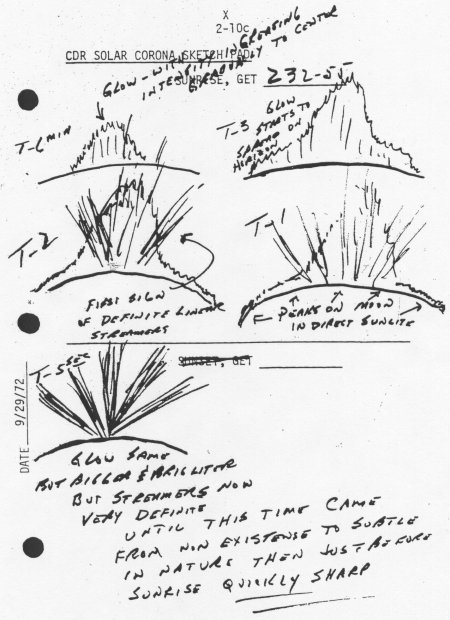
Dust may also be the answer to an enduring mystery that came out of the Apollo missions.  Apollo astronauts reported seeing mysterious glows and rays above the lunar surface.  These could have been caused by sodium ions...or they could have been caused by sunlight shining on dust in the lunar atmosphere.  LADEE will be seeking the answer to this enduring mystery.

A sketch made by Apollo astronauts showing the glows and rays observed above the Moon.  Courtesy Wikipedia.

Watch my blog for more information on when and where to look for LADEE's launch as we get closer to T minus zero.  If all goes well, on September 6, Virginia will be host to an amazing sight - and the start of a 3 to 9 month exploration of more mysteries of the Moon.

Until then,
Carpe noctem!
Kelly

Wednesday, November 21, 2012

Pass the Astronomy, Please

Happy Day Before Thanksgiving!

I'm in a food mood, folks.  I'm looking forward to Thanksgiving this year.  Maybe because I don't have to do all the cooking myself this time!  Or maybe because the Mythbusters took on some classic food myths - including that turkey tale of tryptophan.  But whatever it is...let's take a moment to explore some ways to bring a little astronomical fun to the holiday.

Of course, the first thing that comes to mind is just get outside!  After the massive meal and the inevitable 4 hours on the couch to recover, get up and head outdoors.  It will be dark by then, and maybe you'll be treated to some lovely sights!  As early as 6pm, the Moon will be climbing high towards the south, being just a bit past first quarter at that point.  This will be a great time to get out the binoculars or a telescope and sweep along the terminator - the line of shadow that separates day and night on the Moon (or any other celestial body) - and explore the wonders of the lunar surface.  The deep shadows to be found at the terminator make for an excellent view of mountains, craters, and other magnificent features.

The Moon's terminator.  Note the strong detail visible thanks to the deep shadows.  Courtesy stargazing.net


By 9:30pm, Jupiter will be a blazing beacon of white light in the eastern sky.  It will be tantalizingly close to the red right eye of Taurus the Bull, Aldebaran.  The color contrast should be quite lovely.  And here again, a telescope or binoculars will provide some extra excitement, showing you several Jovian moons and maybe a couple of cloud bands on the massive planet.

Jupiter and its 4 largest moons as seen through a small telescope.  Courtesy Universe Today.


But perhaps you're just not going to be able to get up off that couch.  Maybe we'd better add some astronomical fun to the meal itself, or there's no chance you'll get anything spacey in at all.

One easy way to stellar up any meal is with a little starfruit!  When you slice this unique little fruit correctly, the pieces come out star-shaped.  Scatter them around as garnish on almost any dish - they have a mild, white-grape like flavor which is very pleasant and goes with almost anything.

Star fruit, shown whole and sliced.  Image courtesy www.yummy-ness.tumblr.com

For those who really want to do up the astronomical flair - may I suggest a little pizazz during the pie course?  Big round things always put me in mind of the planets.  Perhaps an apple pie might be topped with a red-food-coloring tinted top crust and become the surface of Mars!  Or the whipped cream on top of the pumpkin or coconut cream pie might be striped to look suspiciously like the clouds of Venus or Saturn.

Gracious, I've just given a whole new meaning to "The Face on Mars," haven't I?


However you celebrate, be it astronomically or not, have a wonderful and peaceful Thanksgiving.
Carpe noctem!
Kelly

Wednesday, September 28, 2011

I'll See You on the Dark Side of the Moon

There is no dark side of the Moon, really.  Matter of fact, it's all dark.

Pink Floyd had it correct, you know.  The Moon doesn't generate its own light...like all the planets and moons of our solar system, it merely reflects the Sun's light.  But what a beautiful reflection it is.  So let's talk a little bit about the Moon.

It's pretty much the easiest thing to observe in the night sky.  It's big, bright, and details can be seen with nothing more than your eyes!  We've been looking at the Moon a long time - ever since man first raised his eyes to the skies.  Every culture around the world has seen things depicted in the patterns of light and dark rocks on the Moon...faces are common, both male and female...and numerous animals have been found cavorting across the face of the Moon.  What you see may depend on your vision, the clarity of the sky when you look, and your own imagination.

(From top) Man carrying sticks, with dog; Rabbit; Human face 1; Human face 2; "The Lady in the Moon" Attributed to Magnus Manske, Wikipedia

When scientists began investigating the Moon, the darker areas were quickly named "mare," Latin for "sea."  Indeed, early astronomers believe that the dark regions on the Moon might be water, filling the low-lying regions of the lunar landscape.  These regions were given names like "Sea of Fecundity," "Ocean of Storms," and "Bay of Love."  Even after men traveled to the Moon and found no water on the surface at all, let alone oceans, seas, and bays, the naming scheme persisted.  There seems to be a permanent connection between water and the Moon

It turns out, there actually is!  The Moon's gravitational influence is the primary reason why we have tides.  The Earth's gravity keeps the Moon in orbit around us.  The Moon's gravity tugs on the waters of Earth, forcing them to move up and down in response to its gravity.  The Sun gets in on the act too, but if the Earth had no Moon, the tides would be all but invisible to us.  Many species of life depend on the constant and regular motion of the tides...and many scientists believe that without the tides, life as we know it on Earth would not be possible.  Turns out those ancient astronomers were on the right track after all - the connection between the Moon and water is extremely important to all of us here on the Earth.

Observing the Moon is easy...just look up!  Okay, well, maybe it's not that easy.  The Moon isn't always visible in our sky - you have to know when and where to look to see itThe Moon's phases, or changes in shape, are caused by our perspective changing as the Moon revolves around us in its monthly cycle.  We see varying amounts of the daytime side of the Moon depending on where the Moon is relative to the Sun as it orbits around us.  Many people assume the best time to observe the Moon is during a Full Moon, since the entire side of the Moon facing us is lit up.  But that's actually not true, for two reasons.  First of all, a Full Moon, by definition, is exactly opposite the Sun, meaning that it rises at sunset and sets at sunrise.  This might sound great - the Moon is visible all night!  But the means that you must wait until around midnight for the Moon to be high in the south, where it is easiest to observe.  And let's face it...most of us are not quite that lunatic.  (Ha!  Fun play on words!)

First Quarter Moon.  Courtesy NASA.

The second reason why the Full Moon is not the best for observing is that during a Full Moon, the light striking the surface of the Moon is coming pretty much from directly overhead, from the lunar perspective.  That means there are virtually no shadows, and very little contrast.  Shadows give you a sense of height and depth - something that really adds to your observing as you look at mountains and craters on the surface and try to get a sense of how high or deep they are.  The best time to observe the Moon is during the First Quarter phase - the Moon is high in the south around sunset, and the dark line the runs across the face of the Moon dividing the daylight side from the nighttime side (it's called the terminator) is perfect for viewing - the shadows there are long and deep, and you get an excellent sense of depth perception when you scan along it with your telescope.

In fact, consider this an invitation to join us here at the Virginia Living Museum on the evening of October 8th.  Not only is that our regular monthly Star Party and Laser Light Night, it also happens to be International Observe the Moon Night, and we will be celebrating!  A First Quarter Moon will be gracing the skies, and, weather permitting, we'll have our telescope trained on it to give you the best view possible.  We'll have some special Moon-based crafts and activities for kids, and the folks from NASA will be on hand with their Driven to Explore exhibit...which includes a rare TOUCHABLE Moonrock!  There are only 8 lunar samples in the world that can be touched - don't miss your opportunity to touch the Moon!  The festivities begin at 6pm, and are FREE to all, except for the planetarium and laser shows ($3 for members, $6 non-members).  We'll see you there!

Until next time...
Carpe noctem!
~Kelly