Subtitle

Written by Kelly Herbst, Astronomy Curator for the Virginia Living Museum. Updated every two weeks, more or less.
Showing posts with label telescopes. Show all posts

Wednesday, June 5, 2013

Woohoo! It's Time to Star Party!

Greetings, astronomy fans!

Ah, the summer star party.  Sounds like a contradiction, doesn't it?

Actually, we're really excited about our summer star parties.  We'll have time in the early part of the evening to view the Sun, which is pretty awesome right about now.  We're in solar maximum, so there's almost always something cool to see.  And by cool, we mean about 8,000 degrees Fahrenheit.  That's the rough temperature of the average sunspot, a cool, dark region on the solar surface.  I know, it doesn't exactly sound cool...but with the rest of the solar surface hovering around 10,000 degrees, suddenly 8,000 doesn't sound so bad.

The Sun today, June 5, 2013.  Image courtesy NASA and Spaceweather.com

Once the Sun sets, we'll be treated to some wonderful sights in the evening sky.  Saturn is prominent right now, and looking awesome.  At a recent overnight event at the museum, we saw 4 moons (out of Saturn's many dozens), Cassini's division (a large gap in the ring system), and even some faint banding in the clouds of the giant planet (yellow and white clouds generally don't make for great contrast, so when you can see them, it's quite lovely).  Saturn is truly a sight to behold in a telescope, and well worth the wait for the darkness of night.  Beyond Saturn, expect to see some beautiful double stars, like Alberio, in the head of Cygnus the Swan...and perhaps a nebula or two, like the the Ring Nebula in Lyra the Harp.

Still from a video of Saturn shot June 2, 2013.  Image by Dash One using Raspberry Pi.

While you're waiting for the darkening sky to reveal it's secrets, we've got a special treat for you.  The United States Air Force Heritage Combo, the Blue Aces, will be rockin' it out in the Conservation Garden from 6-8pm (if the weather is inclement, they'll move into the lobby of the main museum building).  Trust me, you're going to enjoy that!  And did I mention that everything we've talked about so far is free? No really, FREE!

The Blue Aces.

Beyond the freebies, you can support the Virginia Living Museum and see some amazing stuff this Saturday night.  Only during the three evening star parties of summer can you visit our stunning summer exhibit, Bodies Revealed, without paying admission to the museum as well.  Stand alone tickets to Bodies Revealed will be available for $15 for adults and $12 for kids.  Members, of course, are only $7.  The exhibit is an incredible journey through the human body - you won't want to miss it.

Also available is an expanded slate of shows in the Abbitt Planetarium!  At 5:30pm, you can see Microcosm, our show about the parallel developments of space exploration and medical technology that will also propel you into a possible future where human beings can go inside the human body to cures diseases.  At 6:30pm, take a break and rock on with Laser Pop, featuring pop music across the decades.  At 7:30pm, catch a preview of the evening sky with Virginia Skies, a live sky talk with one of our staff astronomers.  At 8:30pm, the rock and roll goes on with Laser Vinyl, a mix of classic rock hits you won't want to miss. Rounding out the night is a Pink Floyd double feature - The Wall at 10pm and The Vision Bell at 11:30pm.  The Wall features selections from that classic album, while The Vision Bell is a fabulous mix of old and new Pink Floyd favorites inspired by the release of The Division Bell.  It's a double header you won't want to miss.  Shows in the planetarium are $6 each, or catch a double feature (any two shows on the same night) for $10.  Members are always half price!

Besides all this fun, the Wild Things Museum Store and the Wild Side Cafe will be open for your shopping and eating pleasure!  Plus enjoy the beautiful gardens as the Sun goes down and the evening cools off.  All in all, our summer star parties should be a blast!  Our first one is this Saturday, June 8, and will be your only chance to see the Blue Aces.  Come out and join us!

Until next time,
Carpe noctem!
Kelly

Wednesday, January 2, 2013

Resolved

Happy New Year everyone!

I hope your 2013 has gotten off to a great start.  For many of you, that may mean making some New Year's Resolutions.  I've never been much for them myself...I often find my enthusiasm for them wanes rapidly after the New Year's celebrations are over.  But if you find yourself in need of some resolutions this year...I humbly present to you these recommendations.

New Year's Resolution #1: Resolve to be more in touch with the universe around you.
Back in the day, humans were very in touch with the universe.  It was our clock, our calendar, a source of wonder and the home of the gods.  Today, many of us go through our lives without ever taking the time to look up.  Make it a mission to spend some time under the stars this year.  We can help!  Every second Saturday of the month, the museum hosts a Star Party.  The first one in 2013 is on January 12 - we'll look forward to seeing you!  Star Parties are FREE and everyone is welcome.

New Year's Resolution #2: Resolve to see some shooting stars.
Virtually every year there's a really good meteor shower to see...and 2013 is no exception.  This year, the Perseids are on tap to put on an excellent show, and that's great news for all you folks who hate having to be outside in the freezing cold weather to do your stargazing!  The Perseids peak on August 12th, so you'll be able to spend a balmy evening in your shorts and t-shirt watching "stars" fall from the sky!  On that night, the Moon will be just past first quarter and will set early, so you can drag out a lawn chair and stare upwards for the rest of the night with nothing to dim your view of the heavens (just get away from any city lights near you).  Some models are predicting a bump up in rates for the Perseids this year, so this one could be pretty neat.  Remember - no telescope or binoculars are needed; the more sky you can see, the better.  Put your back to the constellation Perseus and enjoy the show.

A bright Perseid meteor streaks across the sky.  Image by Stefano DeRosa

New Year's Resolution #3: Resolve to use that telescope in the closet to see something cool.
So many of us have a telescope sitting somewhere gathering dust.  Well, this year, you need to get it out and have it set up and ready to go on Friday, October 11, no later than 11:30pm.  Point it at Jupiter as early as you can, and watch.  Slowly but surely, the shadows of not one, not two, but THREE of the largest Jovian moons will make their way across the giant planet.  A triple eclipse for Jupiter...a triple shadow transit for those of us here on Earth.  It should be a lovely sight in a good sized telescope.


A rare triple shadow transit on Jupiter on March 28, 2004.  Image by Sid Leach.

New Year's Resolution #4: Resolve to watch a rocket take off.
If you can get to Cape Canaveral on November 18th, you'll have the opportunity to do it in person!  If not, tune in NASA TV and watch the launch of MAVEN: the Mars Atmosphere and Volatile EvolutioN mission.  MAVEN will study the Martian atmosphere to see how the loss of materials to space has affected Mars over its long history.  Launches are always cool to watch, and this one should be no different.

An artist's conception of the MAVEN spacecraft orbiting Mars.  Courtesy NASA.

New Year's Resolution #5: Resolve to see the comet of the century...maybe...
There's already a buzz in the astronomical community about Comet ISON - it could be the most amazing comet North America has seen since Hale-Bopp...or it could fizzle.  Currently located beyond Jupiter, this newly-discovered comet is making its way toward a close encounter with the Sun.  If it holds together, it could put on an incredible show during the last two months of 2013.  Early predictions indicate that Comet ISON could reach negative magnitudes (bright like Jupiter or Venus), or even outshine the Moon (2nd brightest object in the sky!) and have a gorgeous tail visible to the unaided eye for weeks or even months.  Other early predictions say it could completely collapse under the pressure of the Sun's light and heat and be a total washout.  The only way to find out will be to watch the skies.

The orbital path of Comet ISON.  Courtesy NASA.
So there you have it - five astronomical things to resolve to do in 2013.  Whatever you choose to do, may 2013 be a year full of joy for all of us.

Carpe noctem!
Kelly

Wednesday, December 5, 2012

Something's Coming...

Come on in, don't be shy, meet a guy, pull up a chair!

Okay, you know it's been a tough day when I break into show tunes.

Seriously, good things are happening around here at the Virginia Living Museum.  It's getting kind of exciting.

First of all, we're getting pretty close to being done with flood recovery!  We hope to have the lower level of the museum reopened very soon.  So watch the museum's webpage for an official announcement on that score, hopefully before the end of the year.  It's been a long, slow recovery process, and we're very excited to get the museum fully opened again.  I hear tell there will even be some new exhibits coming downstairs, which is also pretty exciting!

Naturally, this is an exciting time of year in general, with the holidays in full swing.  I have an 8-year-old daughter at home and that makes Christmas extra-special, I can tell you.  Our annual trip to Christmas Town is coming up this weekend (can't wait!), plus all the decorating and visiting and baking and whatnot the season brings.  The Virginia Living Museum is all decorated up for the season, too.  In the planetarium lobby the tree has a lovely silver and blue theme this year which I think suits us well.  And of course, holiday programming continues in the theater until the end of the year, so don't miss out on that!

Jupiter and its largest moon, Ganymede.  Courtesy STScI.

Most exciting in my book is that this Saturday is our monthly star party and Laser Light Night!  It's a special one, too.  Jupiter is just past its opposition, so the giant planet is close to the Earth and looking fabulous even in a small telescope.  Rising close to sunset and remaining visible all night, we're hoping for the clouds to part and show us a fabulous view!  Ten times larger than the Earth, Jupiter shows an amazing amount of detail with only a small amount of magnification.  Probably the most wonderful thing about viewing Jupiter is that you usually get to see a few of its moons as well - most notably the four Galilean satellites.  These four largest moons of Jupiter were first spotted by Galileo Galilei (hence the name Galilean satellites) in the early 1600s.  He called them "the Medicean stars" since at the time of his discovery of them, his bills were being paid by the prominent Medici family (Galileo was no fool!).  Later, all of the moons of Jupiter we renamed for various lovers of Zeus/Jupiter.  Today, the four largest moons of Jupiter are known as Ganymede, Callisto, Europa and Io.  It's a fair bet we'll get a glimpse of all four of them this weekend, so be sure to join us.  Remember, observing is always FREE!

An artist's conception of an eruption on Jupiter's volcanic moon, Io.  A new panoramic wallpaper will be installed in the lobby of the Abbitt Planetarium this January based on this poster.  Courtesy NASA Langley.
 
 In addition, we'll be celebrating the hard work of the many good people who helped raise funds for the museum's flood relief campaign during Walktober!  This dedicated group of walkers raised over $8000 and counting!  And you can help by purchasing a Walktober Flood Relief T-shirt for only $5 this Saturday during the Star Party.  To thank our walkers, we've got extra shows on the docket, and everyone is welcome.  Check out the schedule online.  Shows in the theater, whether planetarium or lasers, are $6 each, or 2 for $10.  Members always receive half off.

Many other things are coming down the pike for the remainder of the year, so I'd better get back to work!

See you in two weeks! And until then...
Carpe noctem!
Kelly

Wednesday, November 7, 2012

The Most Wonderful Time of the Year

Hooray!  The election is over!

Okay, sorry, I couldn't help myself.  Whether your favored candidate won or lost, I think we can all agree it's been a long and rough election season.  I confess I am happy to be done with political ads, phone calls, and mail.  The holidays are just around the corner, and that is indeed my favorite time of year.

But before we get into the holiday season, we've got something fun coming up this Saturday!  Yes, it is once again time for our monthly Star Party and Laser Light Night here at the Virginia Living Museum.  While the flood damage has stopped us from using our lower level, the observatory is in great shape, and the planetarium is running just fine.  So we hope you'll be able to join us for some great sky watching and planetarium and laser shows this weekend!  Here's a quick preview of what we'll be looking at in the night sky (weather permitting, of course!).

Actually, I can pretty much sum it up in one word - Jupiter.  The largest planet of the solar system has once again returned to the evening skies and we cannot be more excited!  Mars (technically) remains low in the southwestern sky after sunset, but let's face it...it's nothing to write home about.  Even on the flattest western horizon you'll have difficulty finding our little neighbor planet.  It's not very bright, it's a dull orangey color, and at only half the size of Earth it's not particularly big, even in a telescope.  On the other hand, Jupiter is the second brightest of the planets (behind only Venus, now dominating the early morning skies), at ten times bigger than Earth it shines like a brilliant white star and shows amazing amounts of detail in a telescope, and rises in the early evening to then spend the rest of the night crossing the sky.  You can bet we'll have a telescope or two trained on Jupiter throughout the star party.  Join us to see how many Jovian moons we can spot, whether the Great Red Spot is facing towards us, and how many dark cloud bands can be seen on the face of the mighty planet

Jupiter, largest planet of the solar system.  Courtesy NASA

We often spend time hopping around various deep sky objects as well...galaxies, globular clusters, open star clusters and nebulae are frequent sights in our eyepieces.  There's also a chance you might see something impressive without even needing a telescope.  The North Taurid meteor shower will peak in the wee hours of Monday November 12...but it's not unthinkable that we might see a few early shooting stars on Saturday November 10.  The Taurids occasionally produce some brilliant fireballs, so if we do see a meteor, it's likely to be a doozy. 

A Taurid Fireball from 2005 photographed in Japan.  Courtesy NASA.  Photograph by Hiroyuki Iida

In the planetarium we'll be featuring the night sky and lots of great music.  At 7:30pm, I'll take you on tour of the evening sky with Virginia Skies.  Once you've seen the stars in the planetarium, step outside and check out the real thing!  Bring the kids for our 8:30pm laser show: iPop.  It's a great mix of some of today's hottest pop stars...including some of those super-popular teens from the Disney Channel and Nickelodeon.  Hoping for some music more to an adult's taste?  No problem - stick around until 10pm for the psychedelic sounds of Laser Doors...and keep the trip rolling on with Pink Floyd's Dark Side of the Moon at 11:30pm.  It all kicks off at sunset with FREE observing of the night sky...shows are $6 person, or any two for $10.  Members always get their tickets half price.

Okay, in the interests of full disclosure...there's another reason why I'm so excited for the star party this month...it's happening on my birthday, which I share with two wonderful people...a dear friend of mine (Happy Birthday, John David!) and Martin Luther, architect of the Reformation.  I suppose I could nail my doctoral thesis to my church door...nah, it wouldn't make much sense...plus the doors are made of glass anyway...

Until next time...
Carpe noctem!
Kelly

Wednesday, October 10, 2012

So What's on Your Mind?

I came to the shocking realization the other day that I've been writing this blog for over a year now.  It certainly hasn't seemed that long to me.

One of the things I was hoping would happen as I began this blog hasn't really materialized yet.  I'd really love to be fielding your questions...talking about the topics that interest you, my readers, the most.  Anyone is welcome to leave a comment on any post - even if your question has nothing to do with the post!  I'll be more than happy to answer your question...and I might even make it the topic for the next blog post.  So please - ask away!

In the hopes of inspiring some new questions, let me share with you the answers to the questions I get asked most frequently.

Who invented the telescope? -OR- Galileo invented the telescope, right?

Actually, Galileo Galilei did many amazing things that advanced our understanding of the solar system we live in, but inventing the telescope was not one of them.  He was the first person to use a telescope for astronomical purposes, turning his simple instrument on the Moon, the Sun, Jupiter, Venus and even Saturn.  But credit for inventing the telescope is generally given to Hans Lippershey, a Dutch lensmaker. 

Hans Lippershey.  Courtesy Wikipedia.

What was that bright thing I saw last night/morning in the east/south/west?

About 99% of the time, the answer to this question is one of the 5 naked-eye visible planets: Mercury, Venus, Mars, Jupiter or Saturn.  Most often, it's Jupiter or Venus, as they are the brightest of these five, with Venus being the brightest object in the sky after the Sun and the Moon.  The planets are generally brighter than the stars near them, and they won't twinkle the way the stars do, making them stand out against the background stars.  These days, Mars is extremely low in the southwest in the early evening.  In the early morning skies, you'll find Jupiter high in the south and Venus mid-way up in the east around sunrise. 

On rare occasions, the answer to this question is Sirius, the brightest star in the nighttime sky.  You'll find Sirius in the winter sky, easily located by following Orion's famous belt to the left.  Sirius will twinkle quite a bit, and it is impressively bright.

Sirius by the Hubble Space Telescope.  The small white dot in the lower left of the image is a tiny white dwarf companion to the main star.  Courtesy NASA.

Where can I buy a quality telescope?

Some camera shops still carry high quality telescopes, but my personal favorite place to purchase observing equipment is online from Orion Telescopes.  They carry an excellent "house" brand, plus the usual players like Meade and Celestron.  Their customer service is excellent, and their prices are quite reasonable.  One word of caution - be wary of purchasing anything manufactured by Meade.  This once-excellent company was bought out several years ago and now offers little or no customer service, and has become increasing difficult to deal with.  Stick with Celestron or Orion's own stuff. 

Where to NOT buy a telescope (especially with the holiday season just around the corner) is any big box store of any kind.  Most "Christmastime" telescopes are cheap, fall apart quickly, and use inferior optical elements.  A good rule of thumb - if the telescope costs less than $150, you are probably going to be disappointed.

When is the best time to see shooting stars in the sky?

Shooting stars are actually meteors - chunks of rock from space coming in to the Earth's atmosphere at high speed.  When they make contact with the Earth's air, the friction generated by the rocks passage causes the air it passes through to glow - making the streak of light we call a shooting star.  While random bits of rock can plunge Earthward at any time, Earth does regularly pass through rocky debris left behind by the regular orbiting of comets.  Such times are called meteor showers, and they are the best times to go out and look for shooting stars. 

The best meteor showers of the year and the rough dates they peak on are:

The Quadrantids  January 4
The Perseids       August 12
The Orionids       October 21
The Leonids        November 17
The Geminids      December 14

I say rough dates because the exact peak date and time changes every year.  In general, the best time to be outside to look for meteors is around 2AM as the combination of the forward motion of the Earth in its orbit and the rotation of the Earth carrying us in the same direction make it more likely that meteors will be visible.  Astronomy is not a hobby for those who like to go to bed early. 

My birthday was yesterday.  Why couldn't I find my sign in the night sky?

Your "sign" is the constellation in which the Sun was located on your birthday.  During the course of the year, the Sun appears in the sky against the background of the zodiac stars, which are part of 12 (13 if you count Ophiuchus, which the ancients really didn't) different constellations.  Today's astrological signs are generally determined by the way the sky looked 6000 years ago, when astrology was getting its start.  In 6000 years, the sky has shifted a fair bit, mostly because very few motions of the solar system actually occur in even numbers of hours or days or months or years.  So what the newspaper says is your "sign" is actually probably not where the Sun really was on the day you were born. 

For example, I was born on November 10.  According to classic astrology, my sun sign is Scorpius the Scorpion.  However, on the actually date I was born...the Sun was located in the constellation Libra the Scales.  6000 years makes a measurable difference in such things.

However, none of that has to do with why you can't find your sun sign constellation in the sky on your birthday.  You can't find it at night, because it isn't there!  By definition your sun sign is in the daytime sky on the day you were born - because it's near where the Sun is on that day.  So if you want to see your sun sign in the sky...wait for 6 months after your birthday.

So what astronomical question have you been longing to ask?  I await your comments eagerly.

Until then,
Carpe noctem!
Kelly

Wednesday, August 29, 2012

I'm starting to feel a little like Han Solo here...

You know...every time he desperately needs to get away in the Falcon, the darn hyperdrive fails.

Well, as I was anticipating writing a long, lustrous update this week...circumstances conspired against me again.  There's been major flooding here in our part of the world...including right here at the Virginia Living Museum.  We took a very serious flash flood last weekend, with water flooding the lower level of both of our museum buildings.

Water pours over the tops of our floodgates and through the doors to the lower level of the museum.  Approximately a foot of water entered overall in the main museum building.  The Wason Education Center took on about 3 feet of water.
Fortunately, the planetarium was spared any major damage.  Unfortunately, little else was.  We've reopened the museum to the general public, but the lower level exhibits remain closed.  To offset this, admission has been reduced by $5 and the planetarium is included in your general admission ticket (that saves you another $4!).  So if you've ever wanted to stop by and check out a show...now's a great time.  Plus your admission fee and any donation you can make will help us rebuild the lower level of the museum.  Estimates of the total damage are still being made, but believe you me, there's been a lot of damage.  Another great way to support us is to come on out to our Star Party & Laser Light Night on September 8th!  The planetarium and observatory are still in great shape, so we'll be open and hopefully enjoying some clear skies and some great music.

Also uppermost in my mind as I hastily update is the painful loss of Neil Armstrong this past Saturday.  Armstrong was the first man to set foot on the Moon, and his death at age 82 has made me realize that soon there will be very few people left who remember seeing the Apollo Moon landings, and even fewer who actually participated in them.  In fact, of the 12 men who walked on the Moon, only 8 are still alive today (besides Neil Armstrong, James Irwin died in 1991, Alan Shepard died in 1998 and Pete Conrad died in 1999).  As this generation passes, and the American space program shrinks into obscurity,  we run a greater and greater risk of forgetting how to accomplish these amazing achievements...or even disbelieving that we ever did.  Already polls show that some 6% - 20% of Americans do not believe we ever landed on the Moon.

Neil Armstrong 1930 - 2012.  Courtesy Wikipedia.

Such numbers are a slap in the face to the 12 brave men who actually did indeed walk on the lunar surface.  I hope we'll be able to get ourselves back into the space race in the not too distant future.  I hope that our first tentative steps out into the solar system won't turn out to be our last.

And finally, Godspeed, Neil Armstrong.

I'll try again in two weeks.  You hear that, ship?  Hold together!
Carpe noctem!

Wednesday, June 6, 2012

Listen...Do you smell that?

But more importantly...did you see it?

Wow, the transit of Venus was amazing!  Weather locally here at the museum almost killed us...but just at the eleventh hour, the clouds parted a bit, and we got a decent view of the Sun.  We had 5 telescopes trained on it and got views of Venus in all five.  Plus we had the live stream from Mauna Kea in Hawai'i thanks to NASA.  It was an amazing evening, and I think our sold-out crowd really enjoyed themselves!

It's been a crazy day here at the Abbitt Planetarium, trying to recover from our big event, but I wanted to share a few photos with you all.  All of these shots were taken by one of our wonderful volunteers, Eric Hedden.

First, some of our telescopes:


In this image, you can see our 8" Celestron, our Coronado Personal Solar Telescope, and our Sunspotter Keplerian telescope.  We also had our 4.5" Orion refractor in use, plus another couple of our great volunteers brought their double-stacked solar scope for a truly excellent view.

Some images taken quickly through our 4.5" using nothing more than a cellphone:


These were taken with a white-light filter on the 4.5".  If you look closely, you can see not only wisps of clouds going by, but also one or two tiny sunspots in the images.

Finally, a shot through the PST:


This image is red because the PST uses a hydrogen-alpha filter, meaning that only red light is passed through the telescope.  Note that although the image is smaller, the dot of Venus is still quite clear.  It's also mirror reversed compared to the images from the 4.5".  This too was taken simply by holding up a cellphone camera to the eyepiece of the PST.

Aren't they amazing shots!  Just you guys wait until we get our new cameras from Orion up and working!

We might be ready to do some testing with them at the upcoming Star Party and Laser Light Night this Saturday!  Join us for solar viewing early (weather permitting) and evening viewing after sunset (probably starting around 9pm).  Observing is FREE!  Come and enjoy!

We'll also have a great selection of laser and planetarium shows for you.  For summer, we're adding an extra early family laser show so even the little ones can get in on the fun!  At 6:30pm enjoy Laser Beatles, at 7:30pm we'll run Saturn: The Ringworld, at 8:30pm you can rock to Laseropolis, at 10pm get psychedelic with Laser Doors and keep the mood going at 11:30pm with Pink Floyd's Dark Side of the Moon.  Hope we'll see you then!

Until next time,
Carpe Noctem!
Kelly

Wednesday, May 9, 2012

Mars Attacks!

Well, actually, when you get right down to it...we're the ones attacking Mars.

Even as I write, the latest in a long series of robotic explorers is on its way to the Red Planet.  The Mars Science Laboratory, with its already-famous rover, Curiosity, launched toward Mars on November 26 of last year and is expected to touch down on the Martian soil in the wee morning hours of August 6, 2012.  If you're a devotee of Mars-exploring robots, you can sit up and watch the landing at the Virginia Air & Space Center, NASA Langley's Visitor Center.  Some folks from the Virginia Living Museum will be on hand too, discussing the ever-popular question of whether life ever got a foothold on Mars.

Mars is a tough planet to land on.

The road to Mars is a hard one, and landing on the surface is an even greater challenge.  Kind of like the superstitions surrounding the Scottish Play in the theater world, there's a long-held fear of Mars in the space exploration community.  It is definitely picky about what probes it chooses to welcome.  Half of all the missions ever sent to the Red Planet have ended in failure.

Russia's Phobos (meaning fear; also the name of one of Mars' two moons) 1 and 2 both suffered from the "Mars Curse."  Phobos 1 died of a software glitch - it lost its lock on the Sun, and since it was running on solar power, that was the end of that.  Phobos 2 seems to have suffered a similar fate - after a successful Mars orbit insertion and just prior to the scheduled release of two landing probes, contact was lost and never regained.  While the official explanation is an onboard computer failure...the subject of alien tampering was raised, and has never really been silenced.

The last image taken by the Phobos 2 spacecraft.  The dark object is often claimed to be a UFO responsible for the loss of the craft, but is most likely a distorted shadow of the craft itself on the surface of Mars.

The U.S. craft Mars Observer was also mysteriously lost.  Three days before a planned Mars orbit insertion, engineers lost contact with the spacecraft.  We'll never know exactly what happened, but the most likely cause seems to have been a ruptured fuel tank which sent the craft into a massive tailspin.

Russia tried again with Mars 96, with disastrous results.  The fourth stage of the rocket failed to ignite, and the whole kit and caboodle came crashing back down to Earth.  The bulk of the craft seems to have landed in Chile, though no pieces of it were ever recovered.  Russian telemetry on the rocket was severely limited, and no specific cause for the crash was ever identified.

The Japanese tried reaching Mars with the Nozomi (meaning Wish or Hope) spacecraft, but a malfunctioning valve resulted in a loss of fuel so great that the poor craft was left with insufficient fuel to reach Mars orbit.  Some science did come out of the mission though - Nozomi was able to make 2 successful fly-bys of Earth and one of Mars.

Probably the most embarrassing loss of a spacecraft goes to the United States and Mars Climate Orbiter (MCO).  MCO was lost when it traveled out of communications by passing behind Mars 49 seconds earlier than expected.  Contact with the spacecraft was never re-established.  Turns out that while the spacecraft software was written expecting flight data in metric units, engineers on the ground were uploading the data in English units.  The spacecraft ended up flying too close to Mars, and likely disintegrated in the Martian atmosphere.  Oops.

We didn't do much better with Mars Polar Lander (MPL).  Contact with the spacecraft was lost during the descent phase as MPL tried to land at the Martian South Pole.  We never heard from the spacecraft again.  No trace of the craft was ever found, but the official explanation for the loss states that vibrations during the descent phase may have tricked the lander into thinking it was on the ground, and it shut off its thrusters, causing it to plummet the last 130 feet or so to a very hard, fatal landing.

Even the British have had trouble with Mars, losing a lander, Beagle 2 (named for the HMS Beagle, the ship that carried Charles Darwin on his famous voyages).  No explanation or cause has ever been agreed upon - the little lander simply disappeared and never made contact after descending towards the surface of the Red Planet.

Clearly, entry, descent and landing (EDL) is a tough time for a Mars-bound spacecraft.  NASA engineers often call the EDL phase the "7 minutes of terror."  This Saturday, we here at the Virginia Living Museum are going to be celebrating Mars with our monthly star party and laser light night...and we've got a special guest planned - NASA!  Exhibits all about Mars and Earth will be available, and Jill Prince, NASA's Mars EDL expert, will be giving a special talk about the 7 minutes of terror.  If the weather holds, we'll be looking at Mars with our telescopes all evening (plus peeking at Venus and Saturn too, I'm sure!), and there will even be a bit of Mars-themed music in the planetarium with Laser Mania!

So come join us for some Mars Mania this Saturday!  Mars activities and exhibits open at 5:30pm, Jill Prince speaks in the planetarium at 6pm, and observing begins after sunset.  All are FREE!  In the planetarium: at 7:30pm enjoy Virginia Skies (with a focus on Mars); 8:30pm see Laser Mania featuring "Attack of the Radioactive Hamsters from a Planet Near Mars" by Weird Al Yankovic; finish the night with a Laser Pink Floyd double feature: The Wall at 10pm and Dark Side of the Moon at 11:30pm.  All planetarium shows are $6, $10 for any two.  Members are always half price!

Don't forget to watch the news for information on the Mars Science Laboratory landing in August...and let's hope the Great Galactic Ghoul keeps his mitts off this one.

Carpe noctem!
Kelly

Wednesday, April 11, 2012

The Planets Will Go On

Hey everyone!

So I am already excited for this Saturday's Star Party and Laser Light Night here at the Virginia Living Museum.  It's going to be awesome, for two reasons.  Number one is that we'll be enjoying a Titanic theme!  This Saturday, April 14, 2012, is the 100th anniversary of the sinking of the Titanic.  We'll be adding a Titanic flair to the night with a special showing of "Night of the Titanic" at 6:30pm.  Then at 7:30pm, we'll have our regularly scheduled "Virginia Skies" but we'll examine the stars of the Northern Atlantic as well and compare them to what we see here in Virginia.  Finally, at 8:30pm, "Laser Magic" features the theme from James Cameron's "Titanic" - Celine Dion's "My Heart Will Go On."  The punned out version of that title which heads up my post tells you the other reason I'm super excited about this Saturday.

Have you looked up in the early evening sky recently?  There are four - count 'em, FOUR! - planets visible to the unaided eye gracing the sky just after sunset.  It's incredible!  If the weather holds and things cooperate, you've got the chance to see all four of these planets through telescopes at the museum this weekend.  And it's free to boot!  How can you beat that?

Looking to the west in the early evening, you can still see Venus and Jupiter decorating the sky after sunset.  Venus is now substantially higher in the sky than Jupiter - the two have been moving apart steadily since their close encounter in March.  Jupiter is lower and fainter than Venus, so look carefully at the western horizon.  Venus will pop right out at you (it is the brightest object in the sky after the Sun and Moon, after all), but look down below Venus for the brilliant jewel of the solar system's largest planet, Jupiter.

Venus above and Jupiter below. Credit: Kevin Jung.

Turning your attention to the East will show you two more planets!  Mars is high in the south-southeast just after sunset, and is a distinctive orange color.  If you turn and compare colors between Mars and Venus, the decidedly orange tinge of Mars becomes very clear.  Mars' unique color comes from rust - the soil on Mars is rich in iron, and over time that iron has combined with oxygen to form rust.  The legendary windstorms of Mars have carried that rusty dust all over the planet, resulting the The Red Planet's characteristic hue.

Look low to the eastern horizon to see the fourth and final planet - golden-yellow Saturn.  If you can join us this Saturday, it will be well worth hanging around until Saturn climbs above our treetops so you can see it through a telescope.  It is quite possibly one of the most amazing things you will ever see!  Even at a distance of roughly a billion miles, the rings are quite distinctive, and with our larger scopes, you might even glimpse a few details in the cloud layers.

Saturn through a moderate-sized telescope.

We'll start setting up our telescopes around sunset (about 7:30-8pm these days) and will continue to observe until about 11:30pm or so.  Observing is free!  Planetarium programs begin at 6:30pm and are $6 for one, $10 for two (members are always half price!).  Make an evening of it and grab dinner in the Wild Side Cafe beginning at 6pm - they'll remain open until 10pm for food, snacks and drinks (both kid-friendly and adult).  It's going to be a "Titanic" night - so come join us!

See you then...
Carpe noctem!
Kelly

Thursday, March 15, 2012

Sorry, I Was Looking at the Planets

Holy cow, if you haven't been outside lately, get out there tonight.  It's amazing.

I should have updated yesterday, but circumstances beyond my control kept me away from my computer most of the day.  But no matter, one day late doesn't really make a big difference right now.  We've got a planet-palooza underway out there tonight, and there's more to come.

If you've been outside on any clear night in the early evening over the past month or so, you've likely seen two brilliant objects shining in the west.  They are well visible even before the Sun fully sets.  Two bright white shining "stars."  Guess what - those two stars are Venus and Jupiter.  Venus is the brighter of the two.  In fact, it's the brightest object in the sky after the Sun and the Moon.  Jupiter may be the biggest planet in the solar system, but it's much further away (about half a billion miles) and so it looks fainter than our lovely next door planetary neighbor.  These two gorgeous planets have reached their closest approach to one another in our sky, and will now begin steadily moving away from one another.  Keep watching...it's going to be a phenomenal sight to watch these planets part from one another night after night.

Venus and Jupiter in the skies of Pennsylvania in February 2012.  Photo by Jack Fusco.  Courtesy Astronomy Picture of the Day.

To see our other planetary neighbor, the red planet Mars, simply turn around 180 degrees from where you see Venus and Jupiter.  Mars is shining a beautiful deep orange on the eastern side of the sky, again, easily visible well before the sky is truly dark.  A bit dimmer yet again than Jupiter, it is still an impressive sight, especially since the color of Mars is so very obvious.  Past its brightest and slowly fading, Mars will gently, and later more rapidly, dim from our view over the next few months or so.  Enjoy it while it lasts!

Still not enough?  Wait a while, until Venus and Jupiter have set.  By late evening, golden yellow Saturn will rise and join Mars on the eastern side of the sky.  The color difference is lovely between Mars and Saturn.  Break out your telescope and you'll be treated to an delightful view of Saturn's majestic rings.  Breathtaking!

Did you miss our March star party?  It was a fabulous night of clear crisp skies and brilliant planets.  But don't worry, we'll be doing it again on April 14.  Jupiter will have sunk too close to the Sun for good viewing by then, but Saturn will consent to rise earlier, joining Venus and Mars to maintain a powerful trifecta of planets in the early evening skies.  Plus we'll be marking the 100th anniversary of the sinking of the Titanic with special shows in the planetairum.  You can get more information on our website.  See you in April!

Now, if you'll excuse me, I gotta get back to those planets.  :-)
Carpe noctem!
Kelly

Wednesday, December 7, 2011

'Tis the Season

Hey folks!

We started talking holidays two weeks ago, so I thought I'd keep it up, as we get a lot of calls around this time of year about good astronomy Christmas gifts.

My Dad loved Christmas.  He loved shopping...especially if he could get a bargain!  And then to have the joy of giving that bargain to someone and watching their face light up...to him, that was the best thing ever.  But as every good bargain hunter knows...my Dad included...sometimes, a bargain turns out to be a raw deal.  To help you avoid the pitfalls as you shop for your favorite astronomy buff this season, here are my Do's and Don't's of astronomy holiday shopping.

DO find out what your astronomy-lover is looking for.
Anyone into astronomy as a hobby almost always has a list of things they've been just dying to get!  And it doesn't necessarily have to be an expensive list either.  Honestly, this is true for any gift...you're more likely to get the right thing if you ask what the right thing is.

DON'T "name" or "buy" a star for your astronomer.
It's a holiday bummer I deal with every year...a well-meaning shopper buys or names a star for their favorite astronomy-lover through one of a dozen companies offering the service.  Some are even geared towards kids, selling a stuffed animal to go with the gift.  Before you drop the $50 - $150 these things often cost, be aware of several things.  No one can buy or sell a star or the right to name a star.  It is against international law to do so.  These companies charge a lot of money for you to send your name in and they print it in a book that gets locked in a vault.  The names are NOT official, nor will any astronomer ever see them or use them.  These companies use extremely dim stars, well below the limits of human vision, and in some cases below the ability of most amateur-grade telescopes!  You will likely never be able to see the star you've "purchased."  In some tragic cases, I've discovered that these companies have made up stars - adding dots to star charts with a marker where no star actually is located.  At best, these items are a novelty gift...at worst, they are out-and-out fraud.  Save your money for a more practical gift, rather than blowing it on a pretty certificate and a poorly-made star map.

Sirius, the brightest star in the nighttime sky.  Try as you might, you won't be able to rename it for your mom.
Courtesy NASA.


DO purchase a gift membership to your local planetarium for your astro-pal!
A one-year membership to your local planetarium/museum is a gift that keeps on giving all year...and in many cases you can share it with your buddy!  If you're trying to keep costs down, check to see if your museum of choice offers an individual membership - that can be a a great cost-saver!  If you live in the southeastern Virginia area, check out gift memberships to the Virginia Living Museum and give them the gift of the Abbitt Planetarium and Observatory for a year!

DON'T buy a telescope from a big box store.
This time of year, every hobby, outlet, and big box retail chain carries telescopes.  Sadly, these instruments tend to be of poor quality, often breaking down before February.  Quality optical equipment costs between $150 and $400 for a basic instrument, and that money goes into producing excellent optical parts.  A telescope that advertises that it comes with numerous filters, extra lenses, and Barlows for $150 or less means that you will be receiving substandard optics, and guaranteed frustration.  If you're going to invest in optical equipment, purchase from a reputable optical dealer who will work with you for longer than your purchase.  We recommend dealing with Orion Telescopes - they have both high quality products and an excellent customer service department.  If you're not comfortable purchasing direct on the phone from Orion, the Virginia Living Museum is an authorized dealer and we carry a small backpack-type telescope from Orion called a GoScope.  Please come by and check it out!

The Orion GoScope - an easily portable starter telescope for under $200. Courtesy Orion Telescopes.


DO purchase quality optical equipment - even for a kid!
You don't have to spend a fortune to get good quality.  And you don't have to start with a telescope.  A high quality pair of binoculars will give you an amazing view of the Moon and the planets...and they can be used for other purposes if your little astronomer decides to become a botanist next week.

DON'T overspend.
Set a budget and stick to it, or you could find yourself unhappy in January.  If you can't afford a telescope this year, start with something else astronomical!  There are wonderful books available that can keep your astronomy buff happy until they've saved enough to get that first instrument.  There are also amazing home computer programs, excellent star maps, and other quality products they can enjoy.  A few suggestions: 365 Starry Nights by Chet Raymo is an excellent book for the new sky enthusiast; every astronomer should have a planisphere - a permanent map of the night sky - Edmund Scientific's Star and Planet Locator is a great one; Both Astronomy and Sky and Telescope Magazines also make wonderful astronomy gifts that keep on giving for an entire year.

An image from 365 Starry Nights.  This excellent book gives the beginning astronomy buff a different target for every night of the year, including wonderful illustrations like these to help you find it.  Since the sky is largely the same year after year, you can keep working through it until you've seen them all, no matter how cloudy it gets in your local area. Courtesy Chet Raymo.


DO purchase a meteorite as a gift!
Meteorites can be a wonderful gift for someone excited about astronomy, but they can also be very expensive.  Small samples may only cost you a few dollars, larger ones can be upwards of $500.  The most important thing to remember when purchasing a meteorite is to get a guarantee of authenticity.  The vast majority of "meteorites" for sale on the internet are regular old Earth rocks or chunks of industrial slag.  Some are sold by people looking to pull a fast one, others are sold by well-meaning people who genuinly believe their sample is a meteorite.  One good reputable sources for meteorites, trinitite and other such exotic stuff is United Nuclear.

DON'T buy "Moon rocks," "Mars rocks," or "deeds" to solar system real estate.
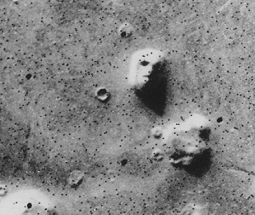
Like the companies who "sell" stars and star naming opportunities, these people cannot truly deliver the product they seem to be selling.  Solar system objects, by international treaty, cannot be owned or claimed by any individual or government, nor are individuals permitted to own pieces of them.  Any company which attempts to say otherwise is at best selling a gag gift, and at worst, committing fraud.  Don't give them your money.

The much-touted "Face" on Mars.  Even if you think it looks like you, you still can't own it.  Courtesy NASA.


As always, if you have any questions about a good astronomical gift, please give us a call or send us an email!  We'll be glad to help you out.  You can even comment here if you like!

Have fun with the holiday shopping, and I'll be back in two weeks!
Carpe noctem,
Kelly