Subtitle

Written by Kelly Herbst, Astronomy Curator for the Virginia Living Museum. Updated every two weeks, more or less.
Showing posts with label exploration. Show all posts

Wednesday, August 28, 2013

Hey there, LADEE!

Okay, the title works much better if you think of saying it with a nice Irish accent.

We're going back to the Moon!  Okay, it's with a robot right now, but hey, let's take what we can get!  LADEE, or the Lunar Atmosphere and Dust Environment Explorer, will launch from the Wallops Island Flight Facility here in Virginia on September 6th.  That means we should have a great view of the launch...as will much of the east coast of the United States, in fact.

The LADEE Spacecraft.  Courtesy Wikipedia.

Wait a minute...Lunar Atmosphere?  Yes, lunar atmosphere.  Most of the time, when we talk about the Moon, we say it has no atmosphere.  That's because for all practical purposes, it doesn't.  There's certainly nothing like air that we could breathe.  And yet, there are some tenuous gases around the Moon...and I do mean tenuous.  The pressure of the "lunar atmosphere" is less than one hundred trillionth of Earth's atmospheric pressure at sea level.  You don't get more tenuous than that!  It seems to mostly be comprised of argon, helium, sodium, potassium and hydrogen, most of which probably comes from outgassing from the Moon itself.  But we'd like to know more about this "atmosphere," where it comes from, and what effect it may have on any future (and perhaps permanent) missions to the Moon.

And then there's dust.  Dust is tricky stuff in space.  It can make for some real problems.  The Moon's surface is covered in dust - lunar regolith is essentially dust-sized particulates and they can get everywhere.  A major challenge for any equipment working in the lunar environment is how to deal with the lunar dust.  The more we know about it, the better we can plan to handle the dust as we eventually head back to the Moon, hopefully, to stay.

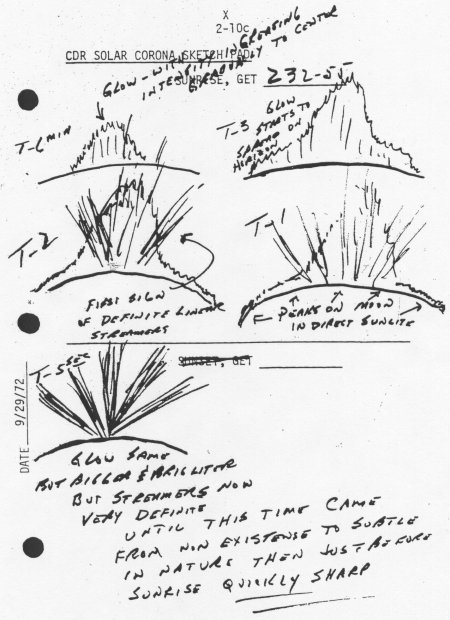
Dust may also be the answer to an enduring mystery that came out of the Apollo missions.  Apollo astronauts reported seeing mysterious glows and rays above the lunar surface.  These could have been caused by sodium ions...or they could have been caused by sunlight shining on dust in the lunar atmosphere.  LADEE will be seeking the answer to this enduring mystery.

A sketch made by Apollo astronauts showing the glows and rays observed above the Moon.  Courtesy Wikipedia.

Watch my blog for more information on when and where to look for LADEE's launch as we get closer to T minus zero.  If all goes well, on September 6, Virginia will be host to an amazing sight - and the start of a 3 to 9 month exploration of more mysteries of the Moon.

Until then,
Carpe noctem!
Kelly

Thursday, August 23, 2012

Beautiful...exciting...and short

Much better than nasty, brutish and short, don't you think?

Forgive my absence, dear readers, but I've been traveling for several weeks and the internets have not always been kind to me.  I couldn't get internet at all for the first few days, and then once I could, no power in the universe was allowing me in to my blog.

But back home again and trying to get caught up, I had to take a minute to share this with you in lieu of the post I should have made a week ago and more.  Please enjoy, and watch for regular postings beginning again this coming Wednesday!

Curiosity photographs itself (at least in part) on Mars.  Courtesy NASA.
Be sure to click the link above and watch the video.  And to think some people believe scientists are boring.
 
Carpe noctem!
Kelly

Wednesday, May 9, 2012

Mars Attacks!

Well, actually, when you get right down to it...we're the ones attacking Mars.

Even as I write, the latest in a long series of robotic explorers is on its way to the Red Planet.  The Mars Science Laboratory, with its already-famous rover, Curiosity, launched toward Mars on November 26 of last year and is expected to touch down on the Martian soil in the wee morning hours of August 6, 2012.  If you're a devotee of Mars-exploring robots, you can sit up and watch the landing at the Virginia Air & Space Center, NASA Langley's Visitor Center.  Some folks from the Virginia Living Museum will be on hand too, discussing the ever-popular question of whether life ever got a foothold on Mars.

Mars is a tough planet to land on.

The road to Mars is a hard one, and landing on the surface is an even greater challenge.  Kind of like the superstitions surrounding the Scottish Play in the theater world, there's a long-held fear of Mars in the space exploration community.  It is definitely picky about what probes it chooses to welcome.  Half of all the missions ever sent to the Red Planet have ended in failure.

Russia's Phobos (meaning fear; also the name of one of Mars' two moons) 1 and 2 both suffered from the "Mars Curse."  Phobos 1 died of a software glitch - it lost its lock on the Sun, and since it was running on solar power, that was the end of that.  Phobos 2 seems to have suffered a similar fate - after a successful Mars orbit insertion and just prior to the scheduled release of two landing probes, contact was lost and never regained.  While the official explanation is an onboard computer failure...the subject of alien tampering was raised, and has never really been silenced.

The last image taken by the Phobos 2 spacecraft.  The dark object is often claimed to be a UFO responsible for the loss of the craft, but is most likely a distorted shadow of the craft itself on the surface of Mars.

The U.S. craft Mars Observer was also mysteriously lost.  Three days before a planned Mars orbit insertion, engineers lost contact with the spacecraft.  We'll never know exactly what happened, but the most likely cause seems to have been a ruptured fuel tank which sent the craft into a massive tailspin.

Russia tried again with Mars 96, with disastrous results.  The fourth stage of the rocket failed to ignite, and the whole kit and caboodle came crashing back down to Earth.  The bulk of the craft seems to have landed in Chile, though no pieces of it were ever recovered.  Russian telemetry on the rocket was severely limited, and no specific cause for the crash was ever identified.

The Japanese tried reaching Mars with the Nozomi (meaning Wish or Hope) spacecraft, but a malfunctioning valve resulted in a loss of fuel so great that the poor craft was left with insufficient fuel to reach Mars orbit.  Some science did come out of the mission though - Nozomi was able to make 2 successful fly-bys of Earth and one of Mars.

Probably the most embarrassing loss of a spacecraft goes to the United States and Mars Climate Orbiter (MCO).  MCO was lost when it traveled out of communications by passing behind Mars 49 seconds earlier than expected.  Contact with the spacecraft was never re-established.  Turns out that while the spacecraft software was written expecting flight data in metric units, engineers on the ground were uploading the data in English units.  The spacecraft ended up flying too close to Mars, and likely disintegrated in the Martian atmosphere.  Oops.

We didn't do much better with Mars Polar Lander (MPL).  Contact with the spacecraft was lost during the descent phase as MPL tried to land at the Martian South Pole.  We never heard from the spacecraft again.  No trace of the craft was ever found, but the official explanation for the loss states that vibrations during the descent phase may have tricked the lander into thinking it was on the ground, and it shut off its thrusters, causing it to plummet the last 130 feet or so to a very hard, fatal landing.

Even the British have had trouble with Mars, losing a lander, Beagle 2 (named for the HMS Beagle, the ship that carried Charles Darwin on his famous voyages).  No explanation or cause has ever been agreed upon - the little lander simply disappeared and never made contact after descending towards the surface of the Red Planet.

Clearly, entry, descent and landing (EDL) is a tough time for a Mars-bound spacecraft.  NASA engineers often call the EDL phase the "7 minutes of terror."  This Saturday, we here at the Virginia Living Museum are going to be celebrating Mars with our monthly star party and laser light night...and we've got a special guest planned - NASA!  Exhibits all about Mars and Earth will be available, and Jill Prince, NASA's Mars EDL expert, will be giving a special talk about the 7 minutes of terror.  If the weather holds, we'll be looking at Mars with our telescopes all evening (plus peeking at Venus and Saturn too, I'm sure!), and there will even be a bit of Mars-themed music in the planetarium with Laser Mania!

So come join us for some Mars Mania this Saturday!  Mars activities and exhibits open at 5:30pm, Jill Prince speaks in the planetarium at 6pm, and observing begins after sunset.  All are FREE!  In the planetarium: at 7:30pm enjoy Virginia Skies (with a focus on Mars); 8:30pm see Laser Mania featuring "Attack of the Radioactive Hamsters from a Planet Near Mars" by Weird Al Yankovic; finish the night with a Laser Pink Floyd double feature: The Wall at 10pm and Dark Side of the Moon at 11:30pm.  All planetarium shows are $6, $10 for any two.  Members are always half price!

Don't forget to watch the news for information on the Mars Science Laboratory landing in August...and let's hope the Great Galactic Ghoul keeps his mitts off this one.

Carpe noctem!
Kelly

Wednesday, August 17, 2011

The Little Robot that Could

Greetings all!

I've got a friend who loves little robots.  And no, it's not Grant Imahara.  She's a science educator here at the museum with me.  And I have to confess, I totally understand.

There's something wonderful about a little, plucky machine, doing its job despite all obstacles.  Maybe that's why we love movies like Wall-E so much - little robots are just so darn cute!  Okay, so I'm anthropomorphizing...a lot.  But I can't help it.  Because the subject of this post is a truly amazing little robot - MER-B, better known as the Mars-exploring robot Opportunity

An artist's conception of Opportunity on the surface of Mars.  NASA

It's hard to believe, but Opportunity and its twin sister, Spirit, arrived on Mars in January 2004.  That's right - this rover, which was designed for a 90-day mission, has now been traveling around on the surface of Mars for over seven years.  That right there is reason enough to love this intrepid little robot.

The science achievements from the Mars Exploration Rover program have been nothing short of extraordinary.  We've learned an incredible amount about Mars and its history.  Thanks to the rovers, we know that Mars did indeed have a wet past, and most certainly still has water which occasionally makes a surface appearance.  Opportunity discovered the first meteorite on another planet - Heat Shield Rock - while investigating the site where its own heat shield landed.  The rover has traveled about 20 miles across the surface of Mars, inspecting rocks, digging holes, taking photographs and measurements, and performing numerous other scientific tasks.  It has survived dust storms, a cranky shoulder joint, and even getting stuck in a sand dune for a time.  Its exploits are far too numerous to detail in this space, but I strongly encourage you to read about them.  Opportunity's story is an incredible one, full of achievement, drama, and most of all, the strength and determination of her human crew back here on Earth.

I felt it was time to interest people in the Mars rover again, because Opportunity has achieved quite a milestone in the past few days.  It has been traveling toward Endeavour Crater on Mars for three years, and at long last, arrived at the massive hole in the Martian surface just last week, sending back this lovely photo.

The far rim of Endeavour Crater as seen by Opportunity.  NASA.

Thus Opportunity begins another new chapter in its long and varied history.  Its twin, Spirit, sadly has ended its mission, and has been out of contact with NASA for more than a year.  But Opportunity seems to still be going strong.  I hope this "Little Rover That Could" keeps on keeping on for a long, long time to come.

If you'd like to see Mars, and wave hello to the rover, check your early morning skies.  Mars shines in the eastern sky before sunrise, looking like a dull orange or yellowish star.  Keep watching it, because Mars and Earth are now approaching each other rather than receding, so the Red Planet will grow steadily in size and brightness in the coming months.  While Opportunity may not be able to see you, nor you see it, it's incredible to think that as you look at a small planet millions of miles away, something made by human hands is driving along, helping us discover the wonders of another world.

Until next time,
Carpe noctem,
Kelly