Subtitle

Written by Kelly Herbst, Astronomy Curator for the Virginia Living Museum. Updated every two weeks, more or less.
Showing posts with label NASA. Show all posts

Thursday, January 16, 2014

Mr. Mojo Rising

You know, maybe I should just go ahead and say that I'll update this every other Thursday.  Wednesday just seems to have some kind of bad mojo about it that makes getting an update done impossible.

However...it was worth the delay, because boy do I have some cool stuff to tell you about.

Yesterday I attended a regional Math & Science meeting held at NASA Langely.  The first part of the morning was devoted to touring around.  Now, I've worked with folks from NASA  Langley for years, and I figured I'd seen most everything cool there at least once.

Man, was I wrong!

First, we went to see the National Transonic Facility.  This extraordinary wind tunnel is one of only two in the world that can effectively scale the "air" in the wind tunnel to match the scale of the model.  This can be critical in testing models of aircraft and even submarines where the forces created by the movement of air or water around the vehicle can translate into huge changes in performance of the craft or fuel consumption of the vehicle.  They've tested many, many type of craft in the tunnel, and it's an amazing process.  We got to walk all around the facility with Scott (our guide), and even stood directly under part of the tunnel itself.  We also got to play a little with liquid nitrogen, which is always fun.  The most amazing tidbits I carried away from our tour:

  • When it was constructed, the NTF wind tunnel used up ALL of the stainless steel available in the U.S. at the time.  ALL OF IT.  They had to buy more from Japan to finish the tunnel!
  • The thickness of the tunnel's stainless steel ranges from 6" down to only 1".  One inch of stainless steel may sound like a lot, but it's nothing when you consider the tunnel is essentially a giant pressure vessel that can be pumped up to 120 psi!  (That's almost 9 times normal air pressure!)
  • To scale the "air" in the tunnel appropriately, sometimes they use liquid nitrogen instead of air.  When that supercold material is used, the entire tunnel can contract 8-10"!  Therefore, the tunnel is fixed in only 2 places...the other stability points have to be flexible to allow for this expansion and contraction, or the tunnel would rip itself apart!

A blended wing-body aircraft model is set up for tests in the NTF's unique wind tunnel.  Even the models have to be made to exact specifications or the testing can damage them!  Image courtesy NASA.

Our second way cool stop used to be known as the Lunar Landing Research Facility.  Under that name, it was where the Apollo astronauts came to learn to land the LEM.  They used a system of pulleys to simulate 1/6th gravity and gave Neil Armstrong, Buzz Aldrin, and all the rest of the Apollo team the chance get a feel for what it would be like to set the LEM down on the Moon!  Incredible!  The facility is now a National Historic Landmark, and would be incredible to visit, just because of that.  Heck, I stood on the same spot where the astronauts were learning to settle down on the Moon!

Today, the facility has been repurposed as  the Landing Impact Research Facility...and its new mission is just as awesome as its old one!  They now use the massive rig and newly-added hyrdo-impact basin (it's NOT a pool!) to perform crash tests of a variety of air- and space- craft!  We even got to see the body of a helicopter that had been used for crash testing!  You can see videos of tests performed at the LandIR Facility on NASA Langley's You Tube channel.  Talk about some guys with serious mojo!  Martin and Justin have what must be one of the coolest jobs ON THE PLANET!

The new Orion space capsule is tossed into the hydro-impact basin at the LandIR Facility.  What a fun job - dropping and breaking things for science!  Image courtesy NASA.

If all that wasn't enough, we got treated to an incredible spectacle while talking with the guys at the LandIR Facility.  Overhead, low and loud, was an F-22 fighter jet performing the most incredible aerobatic stunts I've ever seen!  Turns out these guys have to re-certify every year to be able to perform at airshows, and this guy happened to be doing his re-certification just as we were touring around.  Now that pilot definitely had some wicked mojo rising, let me tell you...his plane looked suspended in mid-air, rolling and pitching and yawing in ways that made me queasy just watching him!  It was an amazing spectacle!

The F-22 Raptor.  Wicked cool at aerobatics too.  Image courtesy Wikipedia

So...I guess what I'm trying to say is, if there's a NASA center near you - get on a tour!  You'll never know what amazing things might be right there in your backyard unless you take the time to check them out!

More mojo in two weeks...
Until then...carpe noctem!
Kelly

Wednesday, October 9, 2013

Politics - The Art of the Possible

The titular phrase of this post references a saying by Prince Otto von Bismarck, Germany's fabled Iron Chancellor.  It's also a wonderful song in the musical "Evita."  It's also something I wish our Congress would get around to remembering.

Politics, at its best, should be a way of blending together various viewpoints to bring about compromises that please the vast majority of the people involved...in our case, us, through our elected representatives.  Sadly, right now, our Congress is behaving like a toddler who's been told he has to eat his Brussels sprouts - mouth tight shut, eyes closed, head in the air, and completely refusing to listen

*sigh*

I've seen numbers estimating the number of people affected by the government shutdown at around 800,000.  Sorry, I think that's a gross underestimation.  Though I guess it depends on how you define "affected."  My guess is they are thinking only of federal workers furloughed.  But the shutdown trickles down into everything.  Here's a case in point.

This Saturday, here at the Virginia Living Museum, we are hosting our monthly Star Party and Laser Light Night.  We were planning on a big event, in celebration of International Observe the Moon Night, which is also Saturday October 12.  NASA Langley planned to join us, with some awesome exhibits about current missions to the Moon and what we hope to do in the future.  The Blue Aces Air Force Band was also going to come out to play some great music on the lawn and get everyone in a great mood for the evening.

Sadly, because of the government shutdown, neither of those things can happen.  NASA is effectively closed (except for essential ongoing mission operations) and the Air Force can't really say that having a band play a local event is essential either.  But it is going to affect us, as many people who might have come out to enjoy these things will now stay home.  We're not federally funded here at the VLM...but we're affected, nonetheless.

On the good side, we'll still be here, doing our regular Star Party thing!  We're hoping to have some extra help on hand viewing the Moon (assuming the weather cooperates!) from the good folks of the Langley Skywatchers and the Virginia Peninsula Astronomy Stargazers.  And there will be the usual slate of planetarium and laser shows to enjoy (ticket purchase required for shows - stargazing is FREE!).  I hope we'll see some of you here for the fun!

In other news,  Comet ISON is improving, and may soon be visible to the unaided eye!  It is a wonderful target for backyard telescopes at this time, and is beginning to show color!  Check it out...

Comet ISON as photographed by Michael Jaeger of Weissenkirchen Austria.  The greenish glow is caused by cyanogen and carbon in the comet's coma.  Courtesy Spaceweather.com 

Look for ISON in the early morning, just before sunrise.  You'll need a telescope, as it is not yet visible to the unaided eye.  Mars will serve as a wonderful guide to finding the comet over the next few days.

Finder chart for Comet ISON on October 9, 2013.  Courtesy Spaceweather.com

Enjoy! Hopefully by next month we will be enjoying a naked-eye comet and a reopened government.
Until next time,
Carpe noctem!
Kelly

Wednesday, August 28, 2013

Hey there, LADEE!

Okay, the title works much better if you think of saying it with a nice Irish accent.

We're going back to the Moon!  Okay, it's with a robot right now, but hey, let's take what we can get!  LADEE, or the Lunar Atmosphere and Dust Environment Explorer, will launch from the Wallops Island Flight Facility here in Virginia on September 6th.  That means we should have a great view of the launch...as will much of the east coast of the United States, in fact.

The LADEE Spacecraft.  Courtesy Wikipedia.

Wait a minute...Lunar Atmosphere?  Yes, lunar atmosphere.  Most of the time, when we talk about the Moon, we say it has no atmosphere.  That's because for all practical purposes, it doesn't.  There's certainly nothing like air that we could breathe.  And yet, there are some tenuous gases around the Moon...and I do mean tenuous.  The pressure of the "lunar atmosphere" is less than one hundred trillionth of Earth's atmospheric pressure at sea level.  You don't get more tenuous than that!  It seems to mostly be comprised of argon, helium, sodium, potassium and hydrogen, most of which probably comes from outgassing from the Moon itself.  But we'd like to know more about this "atmosphere," where it comes from, and what effect it may have on any future (and perhaps permanent) missions to the Moon.

And then there's dust.  Dust is tricky stuff in space.  It can make for some real problems.  The Moon's surface is covered in dust - lunar regolith is essentially dust-sized particulates and they can get everywhere.  A major challenge for any equipment working in the lunar environment is how to deal with the lunar dust.  The more we know about it, the better we can plan to handle the dust as we eventually head back to the Moon, hopefully, to stay.

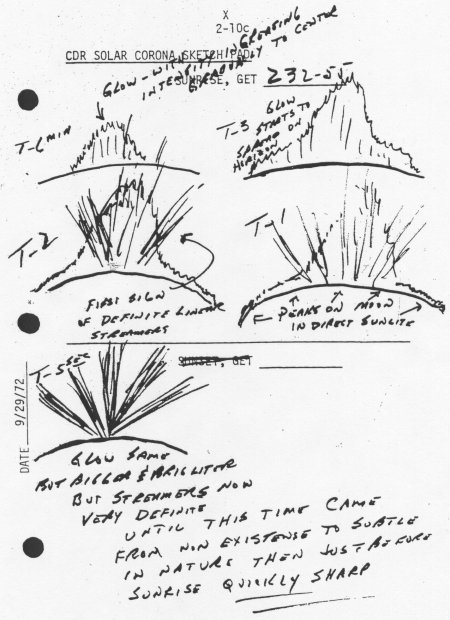
Dust may also be the answer to an enduring mystery that came out of the Apollo missions.  Apollo astronauts reported seeing mysterious glows and rays above the lunar surface.  These could have been caused by sodium ions...or they could have been caused by sunlight shining on dust in the lunar atmosphere.  LADEE will be seeking the answer to this enduring mystery.

A sketch made by Apollo astronauts showing the glows and rays observed above the Moon.  Courtesy Wikipedia.

Watch my blog for more information on when and where to look for LADEE's launch as we get closer to T minus zero.  If all goes well, on September 6, Virginia will be host to an amazing sight - and the start of a 3 to 9 month exploration of more mysteries of the Moon.

Until then,
Carpe noctem!
Kelly

Wednesday, January 16, 2013

NASA and the Fiscal Cliff

Sounds like the title of a fairy tale, doesn't it?  Alas, if only it were.

The fiscal cliff has been the subject of much discussion of late, of course, as our government has chosen to kick the can further down the road before dealing with the issue yet again.  With discussions of this kind, there's something often mentioned by well-meaning folks that just forces me to get out my soap box and hold forth.

It usually begins something like this..."They should just eliminate funding for NASA...we've got problems here at home, we don't need to be worrying about space!"

I grit my teeth, take a deep breath, and find myself standing on the soap box yet again.

First and foremost, the point is often made that even eliminating NASA's budget entirely would do little to save America much money.  In 2011, NASA's funding allocation represented 0.5% of America's overall spending...but that 0.5% represents a full 35% of the total spending on academic scientific research in the United States.  Trimming the budget by 0.5% won't save us much...but slicing the academic research budget by one-third will cripple the course of scientific endeavour in the United States.  We really, really cannot afford that.

How NASA spent its money in every state in the union in 2003.  Courtesy Wikipedia.

Second, listening to some politicians hold forth on the ills of NASA, and how their spacecrafts fail, costing the U.S. taxpayer millions of dollars...I sometimes wonder what they think NASA does with the money.  Let me make one thing completely clear: NASA does not cram their spacecrafts full of dollar bills before launching them into space.  Truly!  All the money apportioned to be spent on a given mission is spent right here on the planet Earth.  Each mission represents dozens, if not hundreds of well-paying jobs for Americans, companies which contract to NASA, and of course, technological developments with a wide range of applications.  Believe me, the money spent on a spacecraft like Mars Observer was still well spent, even when the mission failed.  What was lost was the science payoff.  We missed out on learning amazing things about Mars when we lost contact with the spacecraft...but the money was still safely here on Earth, driving the economy forward.

An artist's conception of Mars Observer at Mars.  It wasn't carrying any money.  Courtesy NASA.
 Finally,  few of us, myself included, fully understand the true benefits we have received from NASA's exploration of the cosmos.  There's the intangible...the wonders of the universe revealed to us...a broader understanding of our own cosmic significance...and a sense of connection with something beyond ourselves.  But let's talk turkey here.  Or perhaps LEDs.  Or scratch-resistant lenses.  Or aircraft anti-icing systems.  Or fire-resistant reinforcement for buildings.  Or firefighting equipment.  Or water purification.  Or solar energy.  Or...okay I think you get the point.  Hundreds of things we use in our everyday lives are made better thanks to technological advances made by NASA in preparing missions.  Those new products and ideas are then made available for companies in the United States to use - by law, NASA cannot charge for them or hold any claim on them.  So the next time you feed your little one nutritious, enriched baby food or you drive safely on the highway in slippery conditions thanks to roadway grooving or radial tires...remember that NASA made those things possible.

A Left Ventricular Assist Device, used by patients awaiting heart transplant.  NASA engineers applied technology developed for the space program to make these devices smaller and more energy efficient, allowing transplant patients to lead normal lives while awaiting a new heart.  Courtesy NASA.
 As I climb gingerly off my soap box, let me say this.  The financial problems faced by America are serious, and cutting of the budget will certainly be required.  NASA is by no means perfect, and there is always room for improving the way it uses the money it is allocated.  But we need to consider long and hard whether in the long run we can safely do without NASA and its scientific research and development of new technologies.  And indeed...the wonderment of discovering the universe around us is truly priceless.

Well, it's rainy (again), lunchtime, and in a few hours I'll be judging a science fair.  Plus I need to grab some protein so I can be ready next time someone needs a good lecture from a soap box.

See you in two weeks!
Carpe noctem...at least once the clouds clear out.
Kelly